Is Wagyu Beef Sold in Us
The Existent Reason Your Wagyu Beef Is Probably False
Shutterstock
There is mayhap no more famous blazon of beef than wagyu. The Japanese beef is widely considered the creme de la creme when it comes to all things bovine, with the highest grades costing up to $200 per pound, co-ordinate to Business concern Insider. All that toll is for skilful reason, as real wagyu is a genuine treat for steak lovers with marbling unlike any other type of beef. Nevertheless the high toll the meat demands — mixed with a general confusion outside of Japan about what, exactly, "wagyu" is — ways that there are too enough of businesses out in that location peddling fake wagyu.
True wagyu from Nihon is rare thanks to strict regulations and both global and domestic demand. The proper noun recognition is undeniable, however, and it seems to appear on menus across the United states. Some of the wagyu sold is real, some of information technology, though, may have misleading labeling and be entirely fake.
Here's how y'all can tell if your wagyu beefiness is false, and why it garners so much attention from consumers and those who attempt to capitalize on wagyu'due south popularity.
There are technically many different types of regional wagyu
Shutterstock
The first thing y'all need to know is that in that location is no one wagyu. In Japanese, "wagyu" literally translates to Japanese cow. Just like how some countries allocate wine and cheese by region, Japan differentiates its beef by region — and there are many types with slightly different regulations, according to Nippon's governmental travel resource. Also like regionally designated wines and cheeses, the production of certain types of wagyu is limited to a sure area. Equally Champagne tin can only come from Champagne, France, sure wagyu tin can just come from certain parts of Nippon.
The most well-known type of wagyu in America is Kobe. Kobe beef comes from the region around the city of Kobe in Hyogo Prefecture. The cows are fed rice and corn, and the meat is known for its sweetness and marbling. Ohmi from the Shiga Prefecture is another famous wagyu with a fine grain, and it was once given medicinally in the 1800s to the shogun ruling class earlier beef became widely available. And then in that location's Matsusaka Ushi, which comes from Matsusaka Urban center in Mie Prefecture. The cows in that location are fed beer and given intense care for a high fat-to-meat ratio.
While those three are the most famous, they aren't the only types of wagyu. There's Yonezawagyu from Yamagata Prefecture, Hitachigyu from Ibaraki Prefecture, Kazusa from Chiba Prefecture, Miyazakigyu from Miyazaki Prefecture, Kumamoto Akaushi from Kumamoto Prefecture, and others.
At that place's a skilful chance your wagyu is labeled incorrectly
Shutterstock
When it comes to wagyu, the characterization may be more than than a trivial misleading. In the mid-2010s, some of New York City'south almost famous steakhouses and restaurants were listing "Kobe" wagyu beef on their menus. An investigation by Inside Edition brought one trouble to lite, however: places similar Old Homestead Steakhouse and Le Bernardin weren't serving true Kobe wagyu beef like what was listed on the menu. The restaurant brand McCormick & Schmick'southward was doing the same, and it had to settle a class-activity lawsuit because of it.
The problem comes downward to labeling regulations gear up by the United States Department of Agriculture. The police states that beef simply has to have 46.ix percent wagyu genetics to sell as wagyu at retail, according to Bon Appetit, and the rest can be angus. Restaurants don't have to listen to these labeling regulations at all and can telephone call any beef they wish wagyu. This makes wading through wagyu beef labels like walking through the Wild Due west of questionable information.
If you're looking to make sure you're definitely getting the real thing, look for "from Nihon" on the characterization. Kobe wagyu that doesn't say "from Nihon" isn't actually Kobe. As Larry Olmsted writes for Bon Appetit, if you're not in one of the few restaurants certified to sell the imported Kobe beef, "only presume any Kobe beef claim is a lie, especially 'Kobe' burgers and hot dogs."
There's more than 1 rating system to classify wagyu beef
Buddhika Weerasinghe/Getty Images
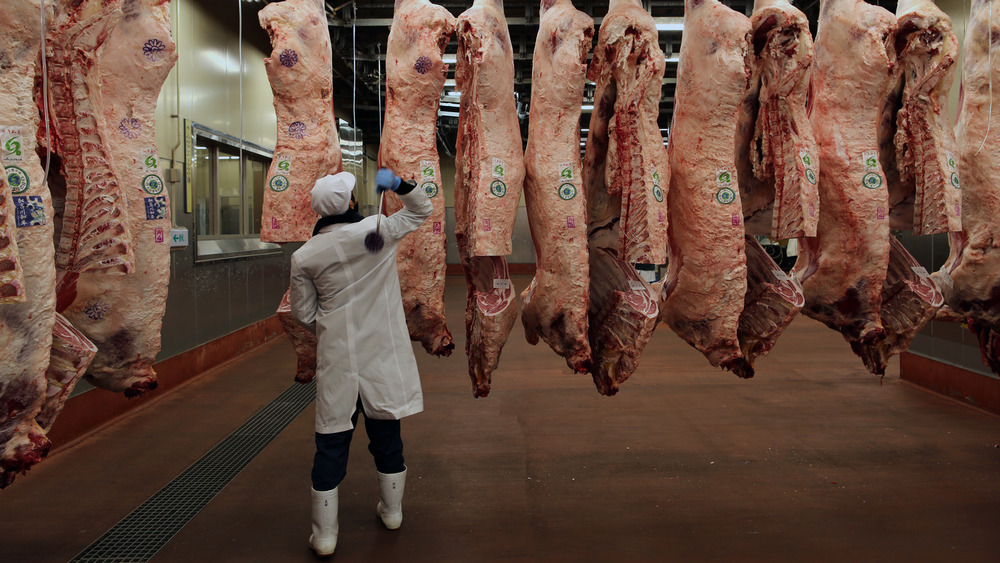
Real wagyu is rated by multiple strict systems in Nihon. The beginning to pay attention to is if the meat is A, B, or C. The letter represents the yield from the cow — A has the highest yield, C is the lowest, and B is somewhere in the middle. This isn't the most pertinent information for consumers, just information technology means a lot to the people sourcing the meat, with A being more desirable.
The 2d organisation is a one through five number that follows the letter class. Wagyu typically has an A4 or A5 (A5 being the highest), according to Robb Report. This is where things get a little complicated, since that number is based on some other number-based rating system chosen the Beefiness Marbling Standard. The Beefiness Marbling Standard goes from 1 to 12, with 12 being the highest level of fat marbling. The A5 rating requires a Beef Marbling Standard rating of viii to 12, while A4 requires a rating of 6 to viii. This makes an A5 12 piece of wagyu the highest you lot can purchase.
These ratings aren't taken lightly in Nippon and it takes three years of training to get a rater, and each cow is rated by iii of these highly trained raters.
American beef grades don't go equally loftier as the beefiness grades in Japan
Shutterstock
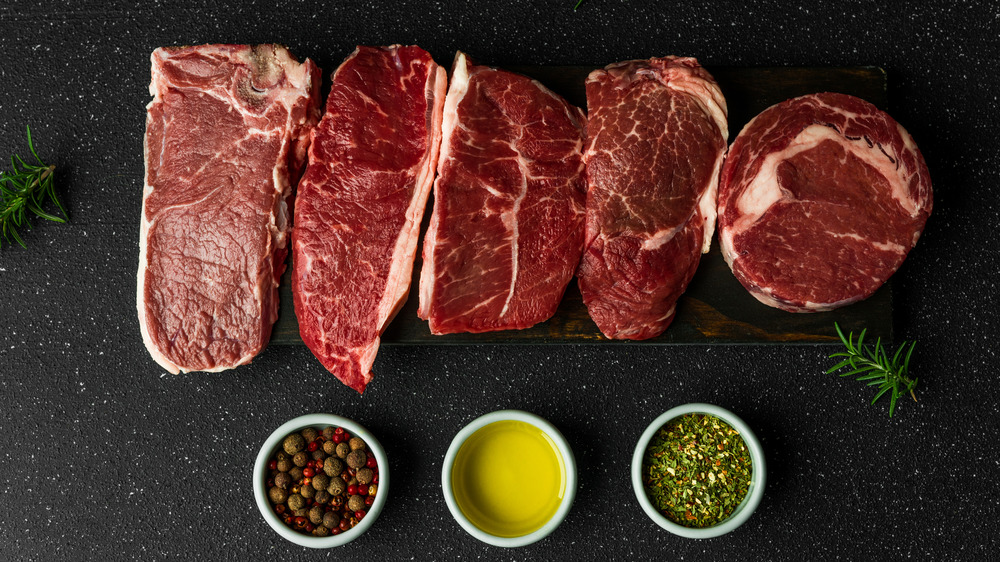
The United States Department of Agriculture is responsible for the beef grading organization in the land. The grades let consumers know the quality of the meat, and the virtually common from everyman to highest are Select, Choice, and Prime. Lower grades, from lowest to highest, include Canner, Cutter, Utility, Commercial, and Standard.
How they go those grades all depends on the yield, fat marbling, age, and other quality factors, co-ordinate to the American Wagyu Association. Even the highest American classification can't account for the fatty marbling in wagyu beefiness from Japan, all the same. That marbling is office of the reason Japan uses such an intense rating organization with the letter rating, the number rating, and the Beefiness Marbling Standard rating.
That's not to say the domestic rating system is bad. The three main ratings are further broken down into plus, neutral, and minus. Texas A&M University has a breakup of the beef grading organisation that shows how even the best class of beef in the U.Due south., Prime, is classified past abundant marbling, moderately arable, and slightly abundant. Yet, when you're looking at the very peak of the line wagyu, you'll need the Japanese rating system to adequately convey the level of fat marbling in the meat because only the Japanese system tin grade such a high level of fat marbling.
For wagyu, it all depends on the breed of the cow
Buddhika Weerasinghe/Getty Images
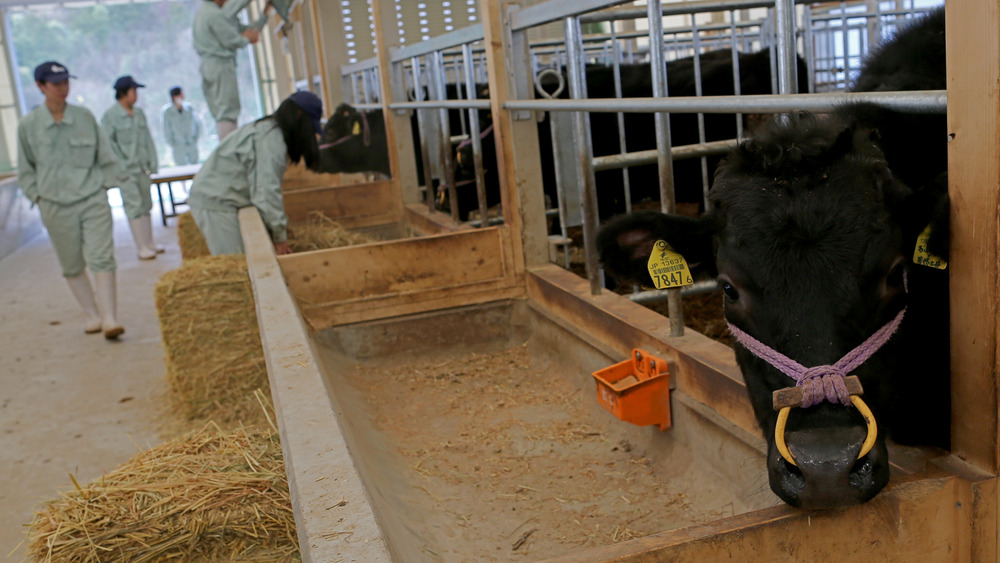
Even though wagyu translates to Japanese cow, not all Japanese cows make information technology into the nomenclature. Only 4 breeds go that special designation, co-ordinate to the American Wagyu Association: Japanese Blackness, Japanese Brown (also called Cherry-red Wagyu in the U.S.), Japanese Polled, and Japanese Shorthorn. Nippon makes certain their cow breeds remain the fashion they are, and progeny testing (meaning testing the parents of each animal) is mandatory to go on the genetic line perfect. The most sought subsequently types of wagyu — Matsusaka Ushi, Kobe, and Ohmi — all come up from Tajima beefiness, which is a subspecies of Japanese Black from Hyogo Prefecture.
Regionality defines each breed, according to the American Wagyu Association. Other popular strains of Japanese Black cattle include Shimane (from Okayama Prefecture) and Kedaka (from Tottori Prefecture). Japanese Dark-brown cattle lines include Kochi, which Oklahoma State University's agriculture department notes is influenced by Korean strains of cattle, and Kumamoto, which is influenced by a Swiss breed of moo-cow. The Japanese Black cows are genetically unique, however, and something in their Deoxyribonucleic acid causes the fat in their body to intermingle with the muscles rather than get together in a fatty cap like other cows, co-ordinate to Robb Written report.
Breeding is tightly controlled past region and the cows and their offspring are kept inside the country. Each calf has an identification number that links the animal to the farm information technology was born at, along with the moo-cow's birthday and bloodline.
There'due south a difference between wagyu and American wagyu
Buddhika Weerasinghe/Getty Images
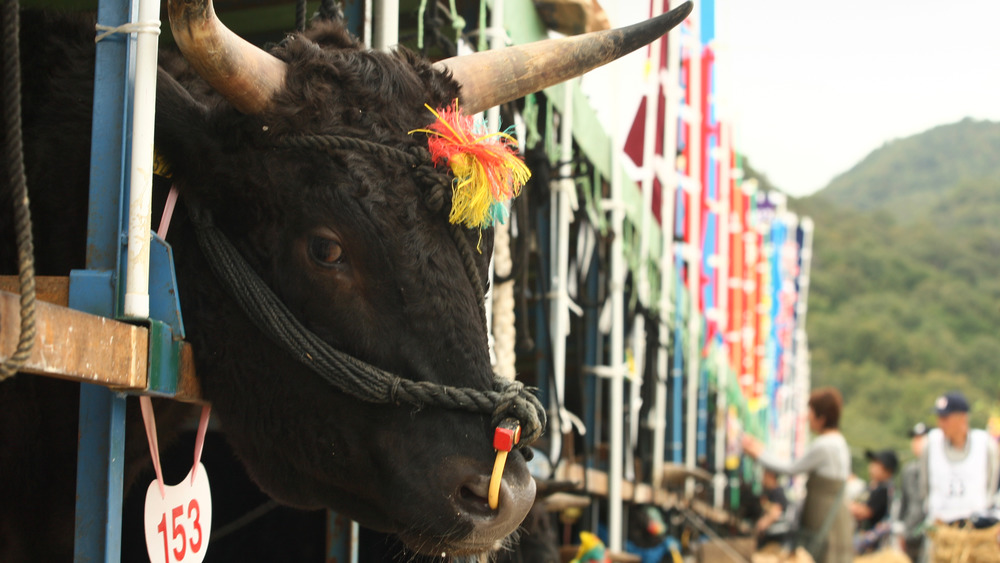
While Japanese imported wagyu is the surest way to know it's the real stuff, there is an American version. Co-ordinate to Oklahoma State University'southward agronomics department, 2 Tottori Black wagyu and two Kumamoto Red wagyu bulls were imported to the U.S. in 1976. Then, in 1993, five Tajima cows (two male, three female) were brought in, and 35 more cattle of various Japanese bloodlines fabricated information technology to American farms in 1994.
Unlike the cows in Japan that were carefully kept apart to brand sure the bloodlines stayed the same, the wagyu in us were crossbred with angus cattle. This has led to the nickname "wangus". Co-ordinate to Robb Report, American wagyu is heavily marbled, just lacks the same consistency, marbling, and season as the Japanese wagyu that's and then heavily regulated.
"The American stuff is wonderful," Joe Heitzeberg, co-founder and CEO of Crowd Cow, told Robb Report. "You can eat more of information technology. With the Japanese stuff, because it'south and then fatty and rich, most people can't consume more than than a few bites of it earlier it'southward then overwhelming. And then if you're in the mood for a steak dinner, and you desire a behemothic steak, you tin can't actually exercise that with Japanese wagyu."
American crossbreeding is more than of an availability issue than anything else. George Owen, executive director of the American Wagyu Association, told Food & Wine that most full-breed wagyu is used for breeding because in that location are and so few of them.
But a select number of American restaurants can serve the highest grades of beef
Buddhika Weerasinghe/Getty Images
Kobe, one of the types of wagyu that people especially chase after, is really difficult to make it the United states. Despite how hard it is today, information technology was fifty-fifty harder a decade ago. For a period of time in the 2000s, it was illegal to import Kobe beef from Japan, which is the merely place real Kobe beefiness can come up from since it must be cut from cows in Hyogo Prefecture.
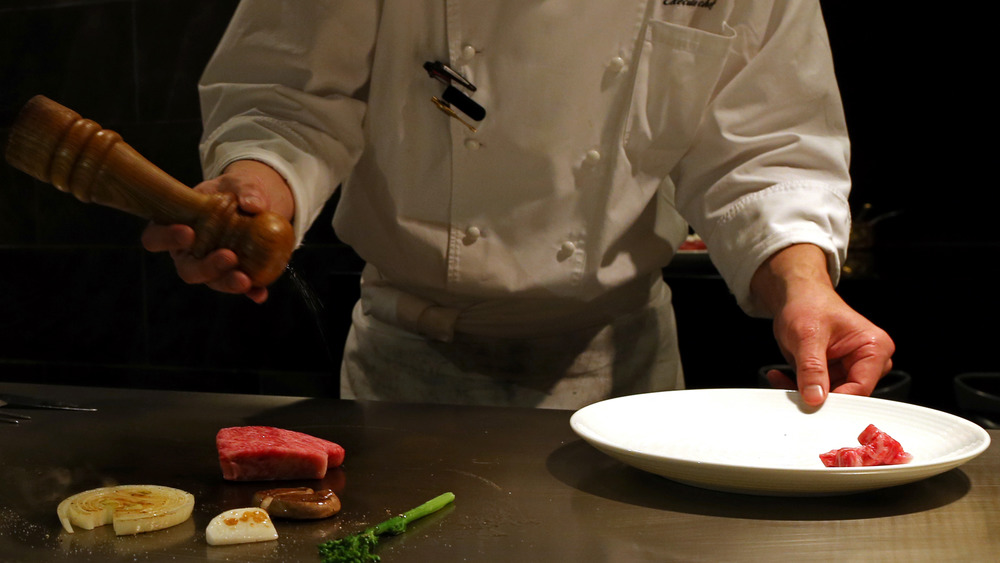
Things aren't quite as dire for Americans who want true Kobe wagyu beefiness today, but it's still difficult. According to Robb Report, the Kobe Beef Association merely certifies approximately 5,000 cows annually every bit Kobe beef quality. All truthful Kobe beef is born, raised, and slaughtered in Hyogo Prefecture before beingness graded according to strict regulations. It's also tracked and only sold to certified retailers and restaurants. That doesn't get out a whole lot of beefiness to go around for all of the people the earth over who want a taste.
Robb Study notes that there are merely 32 restaurants in America certified to sell Kobe beef. New York City (212 Steakhouse), Dallas (Nick & Sam'due south Steakhouse), Las Vegas (Wolfgang Puck), and Los Angeles (Shibumi) are a few of the cities where you can find restaurants that sell Kobe beefiness. Enquire to run into the 10-digit certificate of actuality that whatsoever restaurant selling Kobe beefiness will accept to guarantee information technology's the real bargain.
Authentic wagyu beef has a distinct appearance
Shutterstock
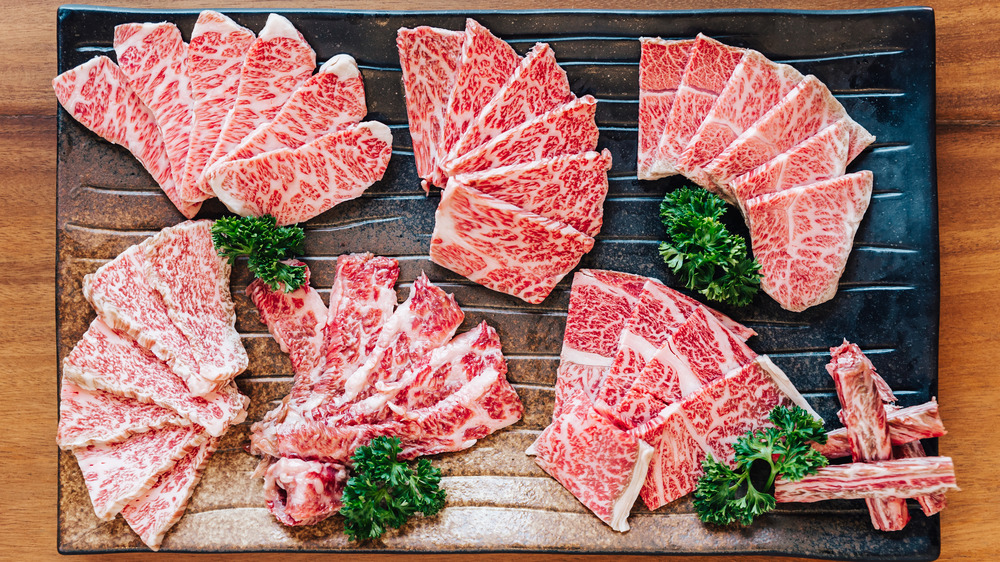
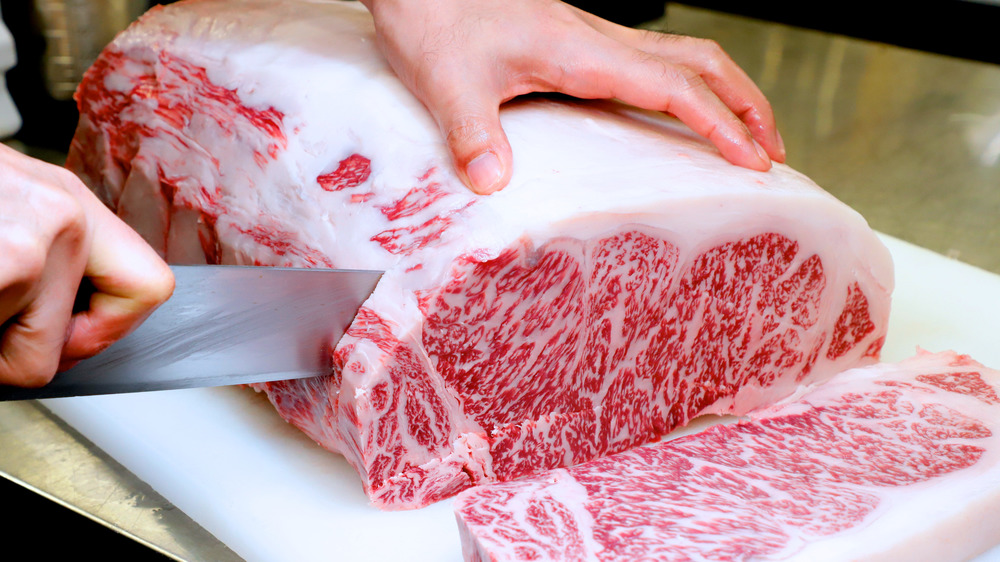
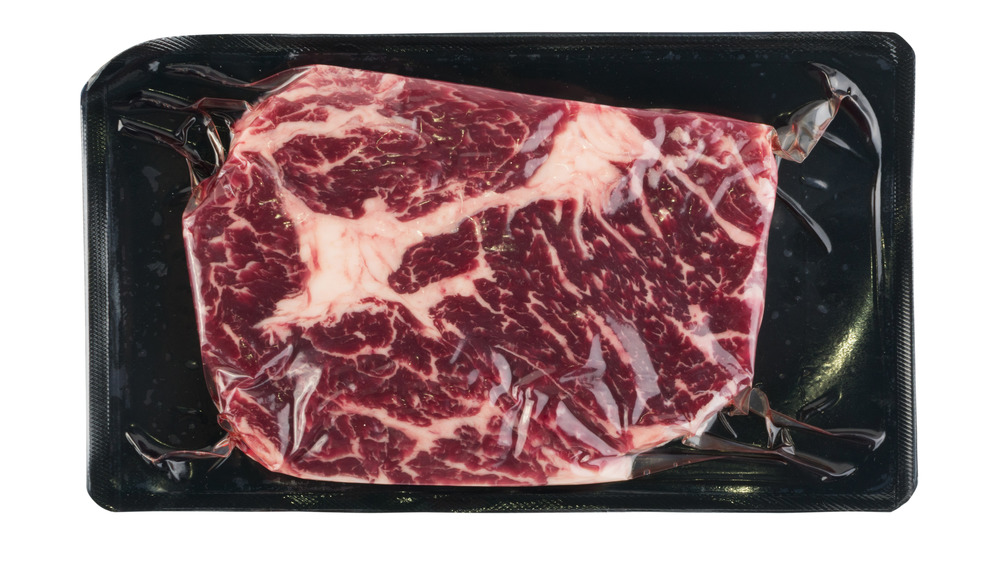
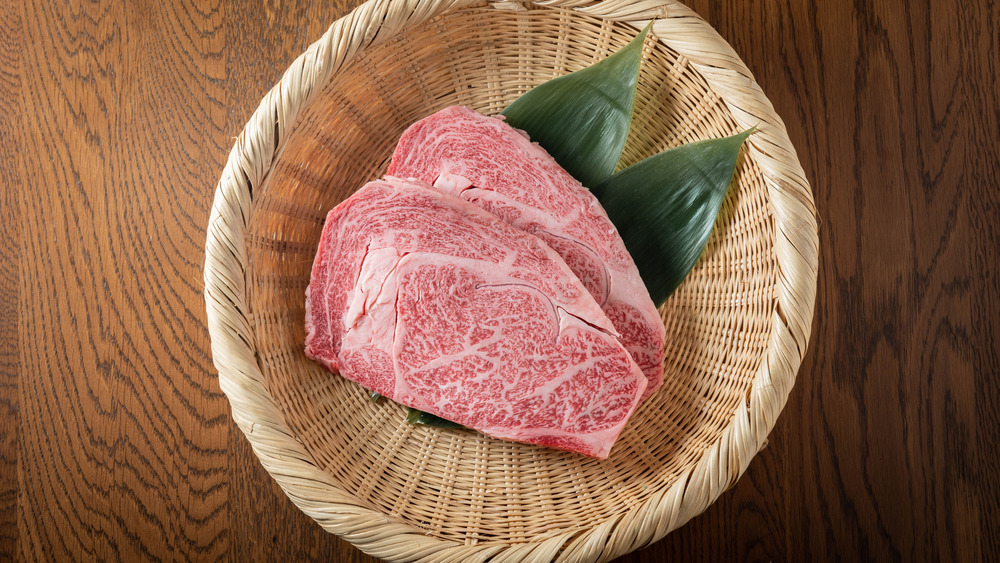
All of that fatty that makes wagyu and then desirable gives an umami sugariness to the beef. Information technology also adds a very distinctive quality that is noticeable right off the bat even before y'all get a taste (if you get to have a taste at all): it's riddled with white webs of fat. In fact, instead of the deep, iron-cherry-red color that you're probably used to seeing, wagyu can come off slightly pinkish because of the unlike ratio of white fat and red meat.
Another giveaway that you tin tell just from the sight is that wagyu beef imported from Nippon is ever boneless, according to Real Simple. That makes it an easy spot compared to all the T-bone, rib optics, strip steaks, and other bone-in cuts sold on the meat aisle of the grocery store or butcher shop.
Co-ordinate to Bon Appetit, these are the things to wait for when seeking a true piece of wagyu: evenly dispersed fat (dots, a spider web, or thin veins are all apt comparisons) and a "uniformly pinkish" color that showcases an integrated ratio of meat and fat. Don't assume wagyu is all that bad for you just because of its high fat content, either. Wagyu has a high level of unsaturated fatty acids like oleic acid making it slightly healthier with the added bonus of having a melting bespeak that'due south lower than the standard human torso temperature of 98.6 degrees Fahrenheit.
Even true American wagyu can undergo genetic testing
Shutterstock
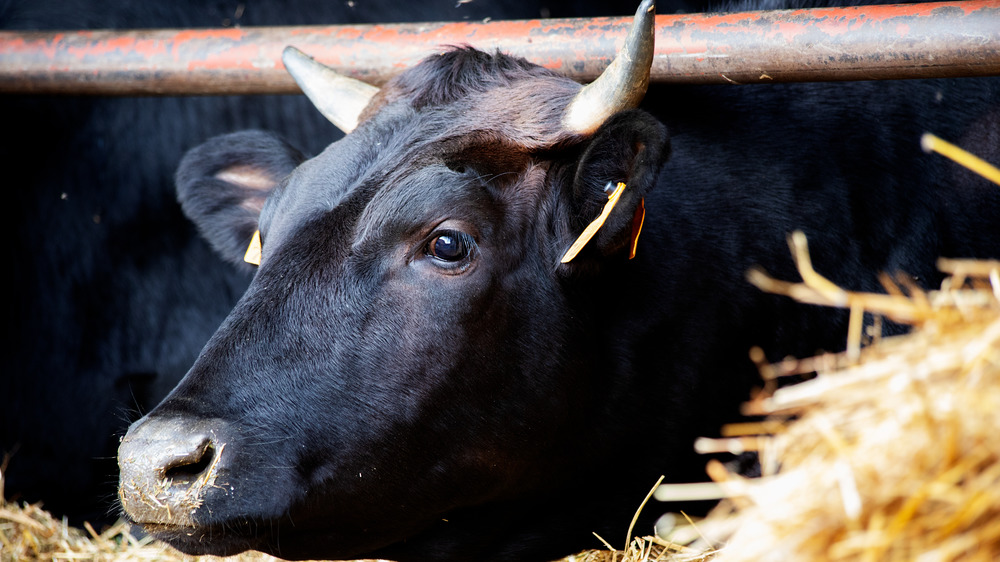
While it is true that American wagyu doesn't undergo the aforementioned detail heavy genetic tests and cattle lineage reports that wagyu from Japan does, that doesn't hateful American wagyu is a total testing gratis for all. Members of the American Wagyu Association can submit for genetic testing and parent verification to be registered as pure-bred wagyu.
American Wagyu Association's 2020 breeders book is filled with companies that certify wagyu cattle for breeding and for eating. Companies similar Y2 Wagyu take both Black Wagyu and Akaushi (another name for Japanese Brown). The testing and certification is run through the American Wagyu Association, and tin only be done for members for a set fee for each exam, certification document, and grading.
It'southward more than than gustation, too. The 2020 breeders book states that ranchers appreciate wagyu "for their exceptional calving ease, longevity, health benefits, and premium carcass quality in a single cantankerous which no other beef breed can offer."
Wagyu beef is raised in a very specific mode
Jeremy Sutton-hibbert/Getty Images
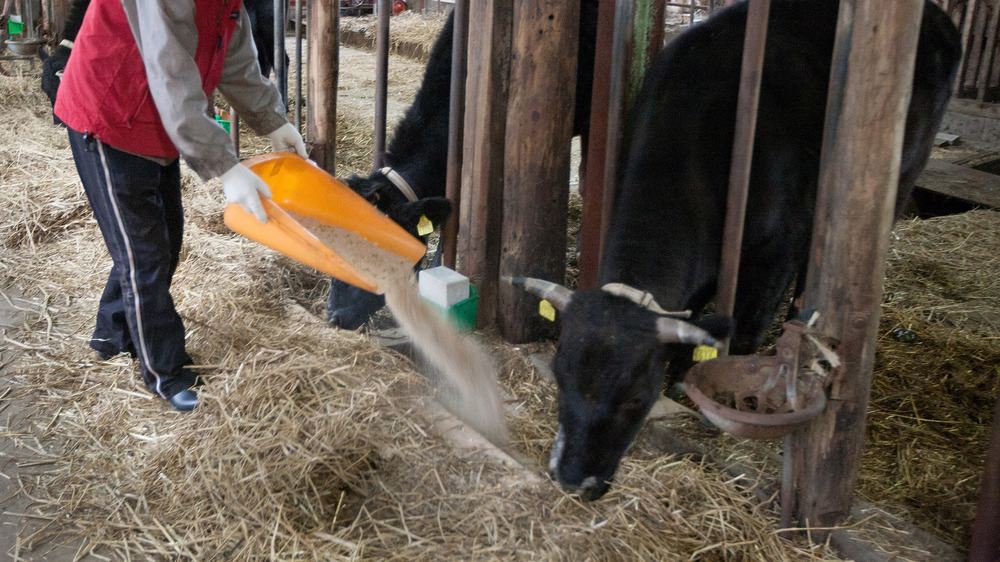
In the days when fake Kobe beef and wagyu were being routinely passed off every bit the real thing, rumors swirled about why the meat was and then special. Some said the cows were given massages or had a nutrition of beer and sake. All of information technology was meant to result in less stressed cows and therefore a better cut of beefiness. Most of those claims were either exaggerated or flat out lies. Yet, wagyu cows from Japan do undergo a good bit of pampering.
The Wagyu Store notes that breeders in Japan practice in fact do everything they tin to make each cow'southward life as stress-free as possible. They get a high-energy nutrition and have plenty of safe space so they don't burn fatty and develop also many muscles. Breeders control the racket, supply clean water, separate animals that fight, and monitor the animals multiple times a 24-hour interval, co-ordinate to Robb Report.
"[Crowd Cow] works with farms that volition check animals every four hours," Heitzeberg told Robb Written report. "In America, if yous're in Montana with a chiliad-plus acres, you may not see your animals for vii days. They're out in that location foraging on the natural Montana grasses, but you don't know what else they're doing."
As for the rumors about beer, in that location is a kernel of truth to that. Japan's tourism website notes that Matsusaka Ushi wagyu is famously given beer "to increase their appetites."
Real wagyu comes in many cuts y'all might not be familiar with
Shutterstock
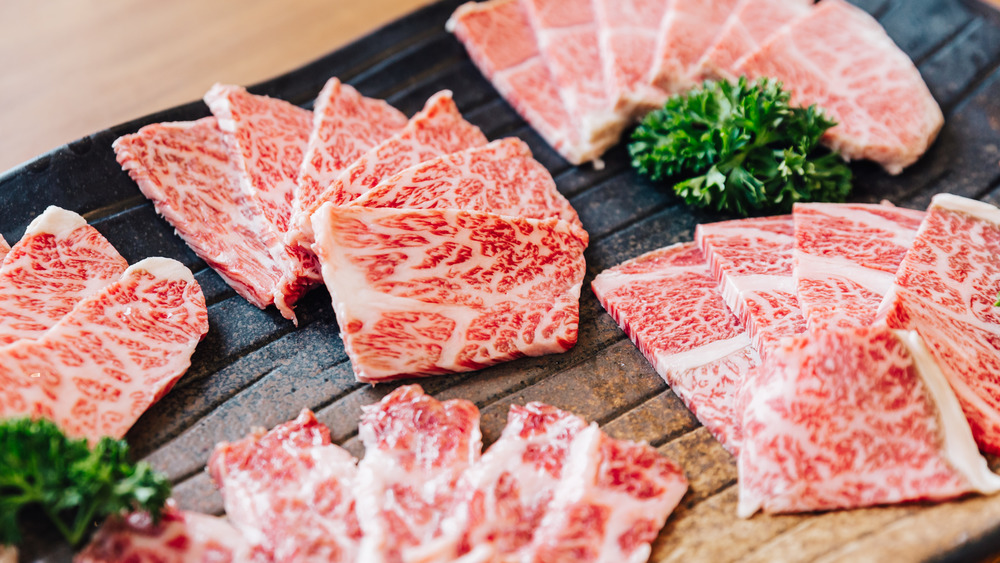
Steak fans know the all-time cuts of beef. Fifty-fifty people who only eat beef occasionally typically know some of the nigh famous, like rib eye, filet mignon, and New York strip steak. Every country has slightly different cuts, though, and the same is true with some cuts of wagyu imported from Japan.
At that place are a few specially popular cuts, according to Live Japan. Sirloin (sāroin in Japanese) is popular as a steak, while rib roast (riburōsu) is popular in the Japanese fondue called shabu-shabu. Haneshita (which comes from a similar area every bit the chuck flap) is some other prime cut, and the same goes for kainomi (the bottom flap of the ribs). There is besides, of form, the offal. Wagyu offal is divided into 22 sections, according to the site Tsunagu Nippon, which are constitute from the natural language to the intestines.
1 of the best means to gustatory modality all of the different cuts of wagyu in Japan is to go to a yakiniku, which is kind of similar a Japanese charcoal-broil spot.
Source: https://www.mashed.com/282674/the-real-reason-your-wagyu-beef-is-probably-fake/
0 Response to "Is Wagyu Beef Sold in Us"
Post a Comment