The Human Eye Can Barely Detect a Star Whose Intensity at the Earth's Surface Is 1.6ãƒâ€”10ã¢ë†â€™11w/m2.
The Globe is often compared to a majestic blue marble, especially by those privileged few who have gazed upon information technology from orbit. This is due to the prevalence of water on the planet's surface. While water itself is not bluish, water gives off blue light upon reflection.
For those of us bars to living on the surface, the fact that our world is mostly covered in water is a well known fact. But how much of our planet is fabricated upward of water, exactly? Like most facts pertaining to our world, the answer is a little more complicated than you might recall, and takes into account a number of different qualifications.
Sources of Water:
In simplest terms, h2o makes up about 71% of the World's surface, while the other 29% consists of continents and islands. To break the numbers downward, 96.5% of all the Earth's h2o is independent inside the oceans as salt water, while the remaining 3.five% is freshwater lakes and frozen water locked upward in glaciers and the polar ice caps.
Of that fresh water, almost all of it takes the class of ice: 69% of information technology, to be exact. If you could melt all that ice, and the World's surface was perfectly smooth, the bounding main levels would rise to an altitude of two.7 km.
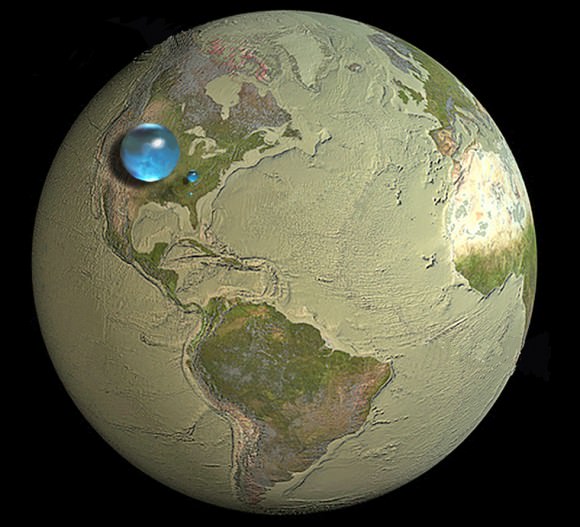
Aside from the h2o that exists in ice class, in that location is also the staggering amount of h2o that exists below the Earth's surface. If you were to gather all the World'southward fresh water together as a single mass (as shown in the image higher up) it is estimated that it would measure some 1,386 1000000 cubic kilometers (km3) in volume.
Meanwhile, the amount of h2o that exists as groundwater, rivers, lakes, and streams would constitute just over 10.half dozen million kmthree, which works out to a little over 0.7%. Seen in this context, the express and precious nature of freshwater becomes truly articulate.
Volume vs. Mass:
Merely how much of Earth is water – i.e. how much water contributes to the bodily mass of the planet? This includes non just the surface of the Earth, but inside too. In terms of volume, all of the water on Earth works out to about 1.386 billion cubic kilometers (km³) or 332.five one thousand thousand cubic miles (mi³) of space.
But in terms of mas, scientists calculate that the oceans on Earth weight about 1.35 10 10eighteen metric tonnes (one.488 x 1018 US tons), which is the equivalent of 1.35 billion trillion kg, or 2976 trillion trillion pounds. This is just ane/4400 the total mass of the Earth, which means that while the oceans cover 71% of the Earth'south surface, they just account for 0.02% of our planet'south total mass.
Source of Earth's Water:
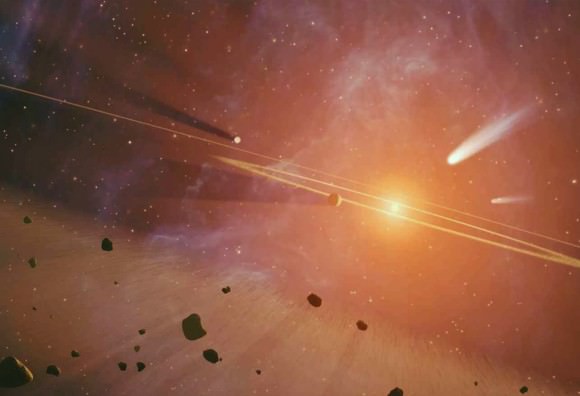
The origin of water on the Globe's surface, also as the fact that it has more h2o than any other rocky planet in the Solar System, are two of long-standing mysteries concerning our planet. Not that long ago, it was believed that our planet formed dry some iv.6 billion years agone, with high-free energy impacts creating a molten surface on the infant World.
According to this theory, water was brought to the globe's oceans cheers to icy comets, trans-Neptunian objects or water-rich meteoroids (protoplanets) from the outer reaches of the primary asteroid belt colliding with the Earth.
Nevertheless, more contempo research conducted by the Woods Hole Oceanographic Institution (WHOI) in Woods Pigsty, Massachusetts, has pushed the date of these origins back further. According to this new study, the world's oceans likewise date back 4.6 billion years, when all the worlds of the inner Solar Organisation were yet forming.
This conclusion was reached past examining meteorites idea to have formed at dissimilar times in the history of the Solar Arrangement. Carbonaceous chondrite, the oldest meteorites that take been dated to the very earliest days of the Solar Organisation, were institute to have the same chemistry as those originating from protoplanets like Vesta. This includes a significance presence of water.
These meteorites are dated to the aforementioned epoch in which water was believed to have formed on World – some 11 million years after the formation of the Solar System. In short, it now appears that meteorites were depositing h2o on Earth in its earliest days.
While not ruling out the possibility that some of the water that covers 71 percent of Earth today may have arrived later, these findings suggest that at that place was plenty already hither for life to have begun earlier than thought.
We've written many articles well-nigh the oceans for Universe Today. Here's How Many Oceans are at that place in the Globe?, Earth Has Less Water Than You Think, Where Did Earth's Water Come From?, Why Doesn't Globe Have More H2o?, Rethinking the Source of Globe's Water.
If you'd like more info on Globe, check out NASA's Solar Organisation Exploration Guide on Globe. And here'south a link to NASA's Globe Observatory.
We've also recorded an episode of Astronomy Cast all about planet Earth. Listen here, Episode 51: Globe and Episode 363: Where Did Earth's Water Come From?
Sources:
- USGS – How much water is there on, in, and above the Globe?
- Wikipedia – Water Distribution on Earth
- Wikipedia – Origin of water on Earth
Source: https://www.universetoday.com/65588/what-percent-of-earth-is-water/
0 Response to "The Human Eye Can Barely Detect a Star Whose Intensity at the Earth's Surface Is 1.6ãƒâ€”10ã¢ë†â€™11w/m2."
Post a Comment