Whats the Big Chiully in Columbus Museum of Art
Arts
'Chihuly: Celebrating Nature' in Columbus
See incredible glass sculptures by artist Dale Chihuly installed among the natural beauty of Franklin Park Conservatory and Botanical Gardens.
The colorful spheres floating among the koi darting to and fro in the Pacific Island Water Garden pond could easily be mistaken for giant beach assurance.
Simply these multihued globes in shades of xanthous, red, green and blue are not inflatable toys. Titled "Niijima Floats," they were created by renowned glass sculptor Dale Chihuly and named for an island in Tokyo Bay and the small-scale Japanese fishing floats he saw on the shores of Washington's Puget Audio in his youth. The glass orbs, which counterbalance between 30 and 60 pounds each, have been on display at Columbus' Franklin Park Conservatory and Botanical Gardens since 2003.
Through March 29, the 124-year-old Columbus landmark is hosting "Chihuly: Celebrating Nature," a collection of the sculptor's exquisite designs that features xix Chihuly installations totaling more than 3,000 pieces of glass from Franklin Park's permanent collection as well equally v boosted sculptures on loan from Chihuly Studio in Seattle.
"When people think of glass art, they oftentimes call up of small pieces," says Bonnie DeRubertis, associate director of exhibitions at Franklin Park Conservatory and Botanical Gardens. "Just Dale Chihuly was a groundbreaker. He was able to re-envision what the medium could exist and button the boundaries to take information technology to a whole new scale."
The conservatory, she adds, is the ideal showcase for the creative person'southward piece of work, since much of it is patterned after forms institute in nature, ranging from the graceful "Marine Blue Herons" on display in the Bonsai Courtyard to the violet "Neodymium Reeds & Light-green Grasses" surrounded by a cacao tree and austral gem ferns in the Rainforest biome.
"Chihuly'due south shapes are so organic, and they really play off the plants we have here," DeRubertis says. "Equally a issue, the colors in the glass popular and the sculptures are completely immersed within the infinite."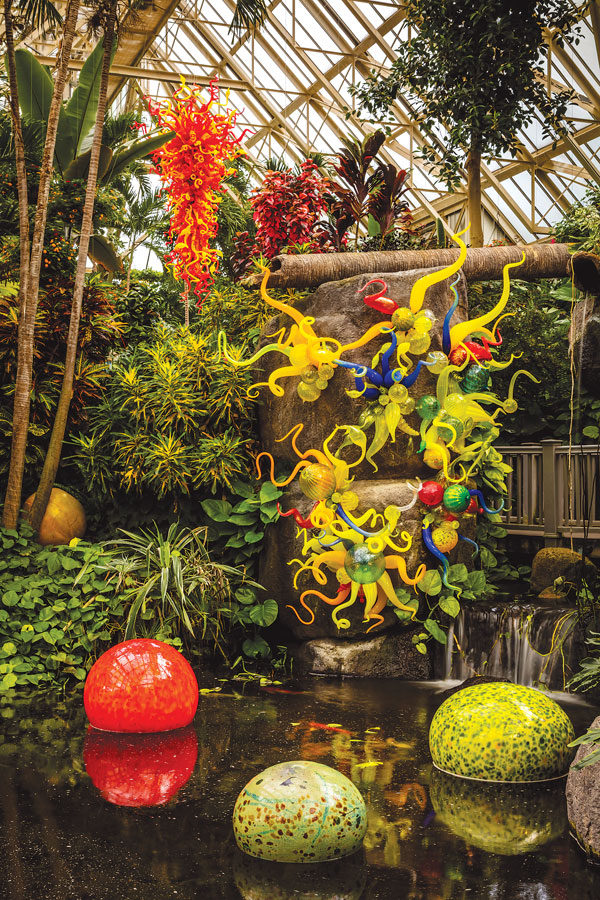
"Nijima Floats" was named for an island in Tokyo Bay and the minor Japanese angling floats on Washington'south Puget Sound. (photo courtesy of Franklin Park Conservatory and Botanical Gardens © Chihuly Studio)
Since much of the art on display has been out of the spotlight since Chihuly'due south last retrospective here in 2009, the exhibition offers a fresh wait at these versatile works, especially those reappearing in new formations throughout the conservatory.
"I dearest the challenge of re-envisioning how something tin can look and experience to the company in a new setting," DeRubertis says, pointing to the "Dusk Chandelier" hanging in the center of the Pacific Isle Water Garden biome. Resembling tongues of red, yellow and orange flames, the vibrant glass is a reconfiguration of Chihuly's "Sunset Tower" sculpture, which had been nestled amongst ferns and philodendron in the Pacific Island Water Garden since 2003.
Afterward Franklin Park Solarium staff members brainstormed with Chihuly and his team most how to present the work in a different way, the iconic 660-piece belfry was dismantled, shipped to Seattle and reshaped. The artist used the glass left over to create "Cerise Reeds & Sunset Sprays," now the centerpiece on the solarium's Asian-inspired Zen Terrace.
"'Sunset Chandelier' feels like the icing on the cake in this beautiful place," DeRubertis says. "I imagine it would exist difficult for an artist to reinvent an installation. But Dale Chihuly was able to wait at 'Sunset Belfry,' in a new way and create two new works of art from it."
***
Heralded as a pioneer of the art glass movement since he began working with the medium during the 1960s, Dale Chihuly is known for his vibrant seashell-like shapes, chandeliers, baskets and constitute-like forms. He and his squad never tire of exploring ideas for new forms that will complement exhibition space at museums and botanical gardens effectually the world.
"Originally, drinking glass was very much a utilitarian material," says Britt Cornett, Chihuly Studio'due south director of exhibitions, who has worked with the creative person since 2005. "But Dale makes it magical. He uses lite, form and colors to create these unique artwork experiences."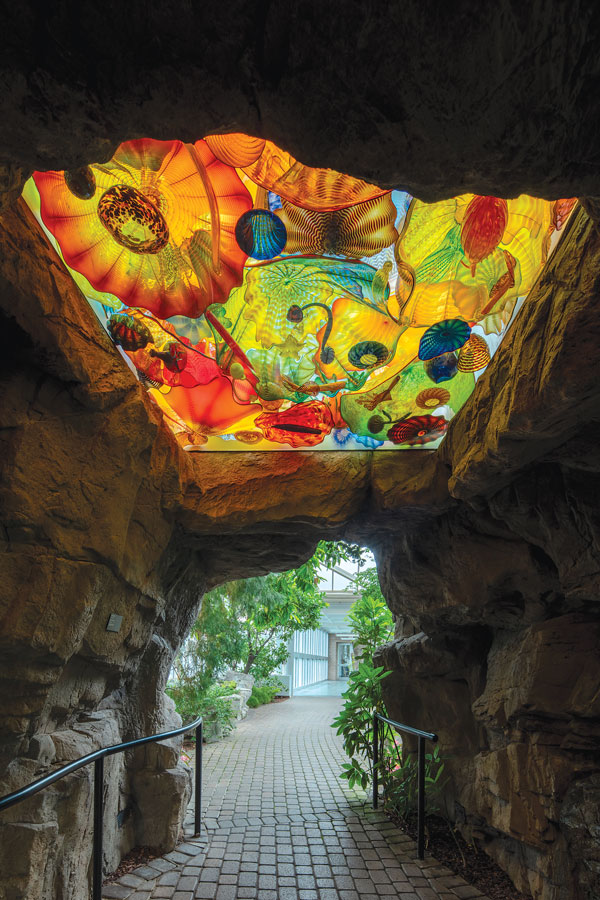
"Western farsi Ceiling" was not predesigned in Chihuly's studio. Glass pieces were fitted into a crenel, then hand-laid by installers from in a higher place. (photograph courtesy of Franklin Park Solarium and Botanical Gardens © Chihuly Studio)
The Tacoma, Washington, native discovered his muse while enrolled in a weaving class at the University of Washington. For his final project sophomore twelvemonth, Chihuly decided to add bits of glass to the material and was absorbed by the way it caught the light. Pilgrimages to Deutschland, Czechoslovakia and Italian republic — besides equally experimentation with melted stained glass and a lifelong interest in architecture and gardens — helped cement his passion. The creative person spent a twelvemonth working as a commercial fisherman in Alaska to earn money for graduate school at the Academy of Wisconsin, where he received his Master of Science degree in sculpture in 1967. Four years subsequently, he founded the Pilchuck Glass School, which led Seattle to become a mecca for artists effectually the earth.
Despite an automobile accident that acquired him to lose sight in his left eye, Chihuly remained undeterred. As his renown spread and then did his commissions. He's created installations for a variety of settings, including London's Victoria & Albert Museum, the 2002 Olympic Games in Common salt Lake Metropolis, Nihon's Toyama Glass Art Museum and Boston's Museum of Fine Arts.
"There's a natural synergy that happens when Dale's artwork is in a natural surroundings among beautiful gardens," Cornett says. "But it can too look fabulous in a very stark environment. I think that versatility is i of the successes that comes through in his career."
***
Equally DeRubertis passes through Franklin Park Conservatory's atrium and into the temperate Himalayan Mountains biome, she offers an invitation to stop and look upwards at a sculpture that's one of her favorites. Equanimous of hundreds of diddled glass forms layered together on plate glass panels, "Western farsi Ceiling" is unique because, dissimilar most other Chihuly works, information technology was not predesigned in his studio. Instead, a crenel was created for the glass pieces, and installers laid each ane by mitt from above, while a team on the basis guided them. The translucent gold "putti" (which means "cherub" in Italian), smiling down on passersby from the center of the space adds a affect of whimsy.
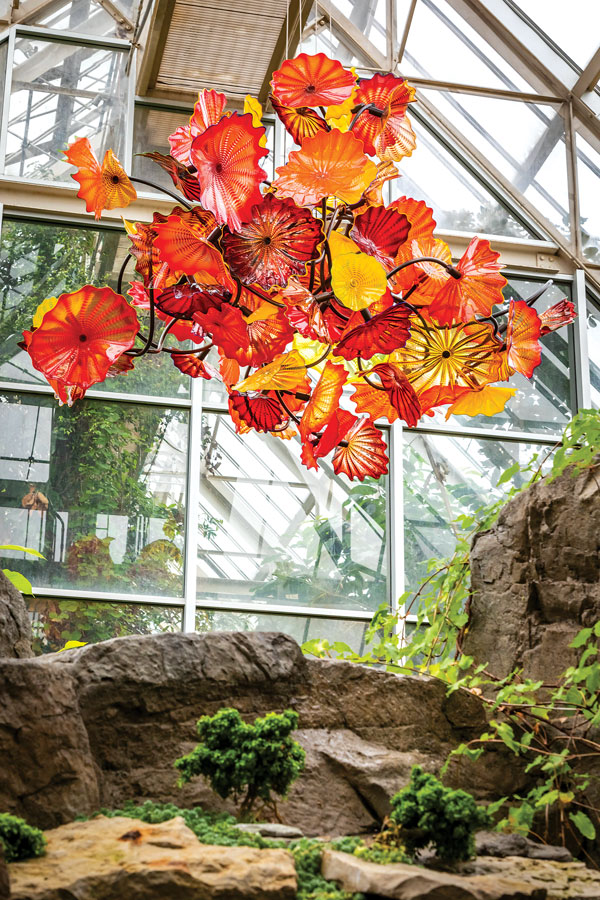
"Sunset Chandelier" hangs in the center of the Pacific Island Water Garden biome. (photo courtesy of Franklin Park Solarium and Botanical Gardens © Chihuly Studio)
"At that place is something really fun almost this," DeRubertis says. "Some visitors say it reminds them of watching fish swim past in an aquarium. Although this piece is stationary, it's just equally mesmerizing."
The Himalayan Mountains biome is besides abode to the seven-piece translucent "Macchia Woods." To give the illusion of illumination, Chihuly applied a layer of white drinking glass between colors to preclude them from blending. Pieces of colored drinking glass are fused to the surface during the glassblowing procedure to produce the mottled upshot for which it is named.
"During these garden shows, you have people coming to feel the conservatory and they discover Dale's art," Cornett says. "On the other mitt, you have people who know who Chihuly is and are visiting the garden for the first time to see his piece of work.
"It is," she adds, "a wonderful cross-pollination that leads to a beautiful sense of discovery."
Franklin Park Conservatory and Botanical Gardens
1777 E. Broad St., Columbus 43203, 614/715-8000, fpconservatory.org
Hours: Monday.–Sun. ten a.one thousand.–five p.m.
Access: Adults $19, seniors $xvi, children 3–12 $12, 2 and under free
Source: https://www.ohiomagazine.com/arts/article/chihuly-celebrating-nature-in-columbus
0 Response to "Whats the Big Chiully in Columbus Museum of Art"
Post a Comment